
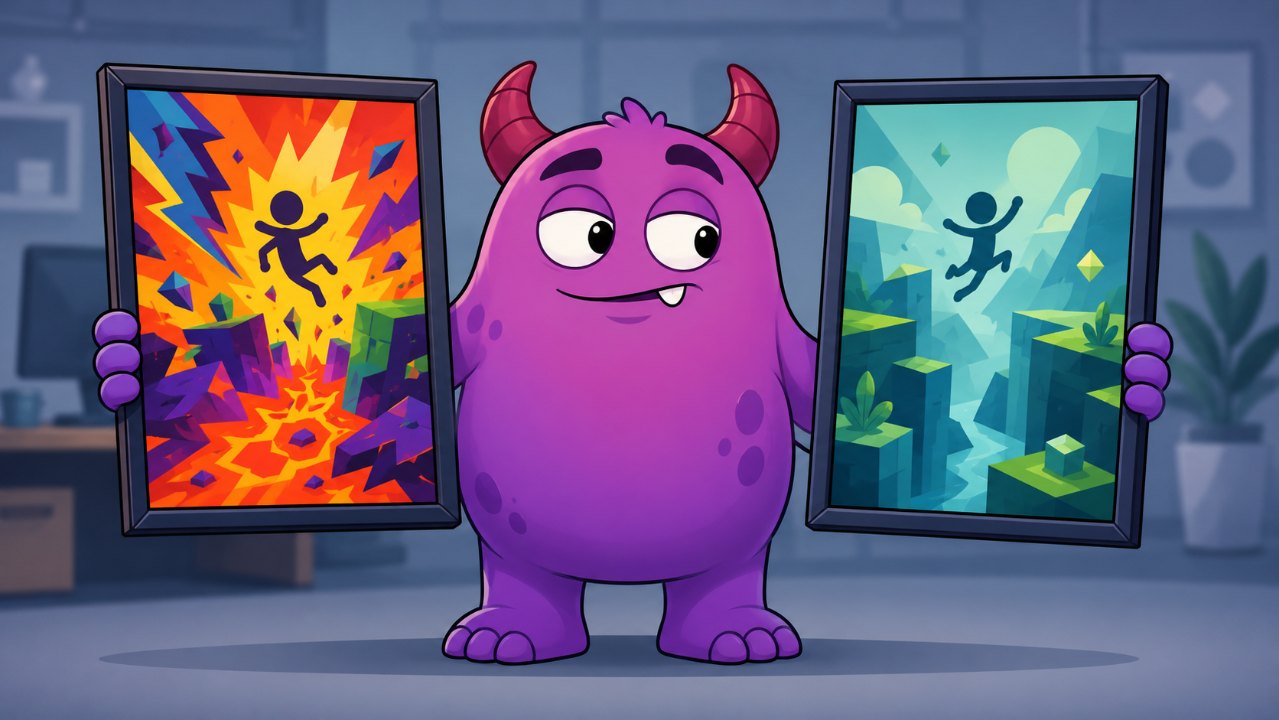
Mobile game ad creative best practices in 2026 focus on fast concept testing, platform-specific hooks, playable and interactive formats, localized variants, UGC-style storytelling, and tight performance feedback loops. The strongest UA teams treat creative as a repeatable testing system, not a one-off production task.
Mobile game UA has become more creative-led because targeting has tightened, automation has taken over more media buying decisions, and acquisition costs keep punishing weak hooks. That means polished assets alone are not enough. Winning teams need a system for generating, testing, learning, localizing, and scaling creative, and that is where performance creative becomes an operating model, not a design exercise.
Artstash Creative sits in that lane: strategy, production, and iteration tied to UA outcomes. If the creative loop is broken, media efficiency follows it down.
What makes mobile game ad creative perform in 2026?
Short answer: mobile game ads perform when they earn attention in the first three seconds, show the game clearly, match the platform and audience, and feed a fast testing loop. In 2026, creative quality is no longer just about polish. It is about how quickly an ad proves the fantasy, mechanic, or payoff the player actually wants.
The blunt version: most studios do not have a creative volume problem. They have a creative learning problem. Without a clear loop, more ads just means faster waste.
What matters most
- Strong first 1 to 3 seconds
- Clear gameplay or value proposition
- Immediate emotional hook
- Format-market fit
- Creative iteration speed
- Platform-specific execution
- Testing discipline
- Localization
- A strong creative analytics loop
| Driver | Why it matters | What good looks like |
|---|---|---|
| First 1 to 3 seconds | Stops the scroll | The hook lands before the skip reflex |
| Clear gameplay | Reduces mismatch | Players see what they will actually do |
| Emotional hook | Creates intent | Competition, mastery, humor, or reward shows up fast |
| Format-market fit | Improves relevance | The ad feels native to the channel and region |
| Iteration speed | Prevents fatigue | New variants ship before performance decays |
| Platform execution | Matches inventory | Meta, TikTok, AppLovin, Unity, Google App Campaigns, and Moloco all want different creative language |
| Testing discipline | Separates signal from noise | Hooks, bodies, and CTAs are tested in controlled batches |
| Localization | Expands performance | Language, pacing, humor, and store cues adapt by market |
| Analytics loop | Guides the next round | CPI, CTR, IPM, ROAS, retention, and fatigue all inform what ships next |
The 7 best practices for mobile game ad creatives
- Start with the hook, not the asset. The opening seconds should sell the core fantasy, mechanic, emotion, or challenge. If the first frame is generic, the rest of the edit is already fighting uphill.
- Show real gameplay quickly. Avoid over-polished creative that misrepresents the game. Demonstrate the mechanic, progression, reward loop, or player decision fast enough that the user understands the promise before they scroll away.
- Build creative around player motivations. The best ads map to why people play: competition, mastery, collection, progression, humor, puzzle-solving, social status, nostalgia, or customization. Good creative does not just show the game. It sells the reason to care.
- Use multiple creative formats. UGC-style ads, playable ads, statics, trailers, live-action, influencer-style concepts, CGI, and 2D or 3D animation all play different roles. A balanced mix beats a single overused format.
- Test concepts before scaling production. Test hooks, formats, visual treatments, messaging, CTAs, and audience angles in small batches before you commit to full production. A weak concept becomes an expensive problem once it is fully rendered.
- Localize beyond language. Adapt characters, voiceover, humor, pacing, cultural cues, regional store expectations, and platform norms. Translation is table stakes. Market fit is what moves CPI. Transcreation is a core part of what we ship. Eleven of our 32 published projects involved localization work, including Free Fire for MENA and Love & Pies for Japan. See our client work for the full picture.
- Connect creative output to UA performance data. Use CPI, CTR, CVR, IPM, ROAS, retention, and creative fatigue signals to guide the next iteration. If the data is not shaping what ships next, the testing process is theater.
Performance creative is not a design philosophy. It is an operating model.
For teams that want a cleaner execution path, this is where a focused workflow matters. Performance Creative for Games should connect directly to User Acquisition, Ideation and Production, and Cinematic Trailers so creative strategy does not sit in a silo.
Best mobile game ad formats and when to use them
| Format | Best for | Strength | Watch-out | Example use case |
|---|---|---|---|---|
| UGC-style video | Cold prospecting on Meta, TikTok, and Reels | Feels native and stops the scroll | Can look repetitive if the creator angle never changes | A creator reacting to a boss fight or rare win |
| Playable ads | Casual, puzzle, merge, and hybrid-casual installs | Lets users experience the core loop before install | Needs a simple mechanic that teaches fast | A mini puzzle that mirrors the first session |
| Cinematic trailers | Brand building, premium IP, pre-launch, and store support | Great for mood, world, and fantasy | Can look impressive while failing to drive installs | A launch trailer for a story-led RPG |
| Gameplay-first video | Most mobile UA campaigns | Shows the actual product fast | Gets stale quickly if the clip never changes | A 10-second loop of the core mechanic |
| Statics | Retargeting, simple offers, rapid testing | Cheap, fast, and easy to localize | Weak if the game needs motion to make sense | Feature-led end cards or offer prompts |
| Live-action | UGC, character-driven storytelling, creator-led hooks | Human face builds trust quickly | Can drift away from gameplay if not anchored tightly | A reaction-led ad for a casual title |
| CGI or 3D animation | Fantasy-heavy games, premium positioning, concept ads | High visual impact and flexibility | Overproduced work can hide the game | A stylized battle moment or character reveal |
| Influencer-style creative | Social proof, creator-led awareness, platform-native storytelling | Adds authenticity and familiarity | Needs real creator energy, not scripted stiffness | A creator walkthrough with a strong opening claim |
| App store preview video | Store conversion and intent capture | Supports the final install decision | Must align tightly with the ad promise | A short preview reinforcing the mechanic seen in ads |
No single format wins forever. The best UA teams build a creative mix, then test continuously so winners rotate before fatigue catches up.
How to build a mobile game creative testing framework
- Research competitor and genre patterns. Study the market before you brief production. Look at the hooks, promises, formats, and gameplay moments that repeat across winners, then identify what is missing.
- Define player motivations. Decide which fantasy each concept should sell, such as mastery, competition, collection, humor, progression, or customization.
- Generate creative hypotheses. Turn those motivations into testable ideas. Every concept should answer one question, not five.
- Produce small batches of concepts. Ship multiple hooks and bodies instead of one polished hero asset. Volume only matters when each variant teaches you something.
- Test hooks and formats separately. Isolate the opening three seconds from the rest of the creative so you know whether the problem is the idea or the execution.
- Analyze creative performance. Read CPI, CTR, CVR, IPM, ROAS, retention, and fatigue together. One metric alone rarely tells the truth.
- Scale winners. Push the strongest concept into broader production, then adapt it for channels, audiences, and regions.
- Refresh fatigued concepts. Replace winners before they collapse. The goal is not just to find a good ad. It is to keep finding the next one.
- Localize winners for priority markets. Translate the asset, then adapt the pacing, humor, voiceover, and store experience for each market.
Why concept and execution must be separated
A good idea with weak execution can fail. A polished asset built on a weak concept can also fail. The only way to know what is actually working is to test the idea, the opening, and the body in a controlled sequence.
Simple operating cadence
- Weekly: hook testing and quick swaps
- Biweekly: concept review and variant expansion
- Monthly: market-level performance readout and localization priorities
This is where Ideation and Production and User Acquisition need to sit in the same workflow, not different teams passing files back and forth.
Fake gameplay ads: why they work, why they backfire, and what to do instead
Every UA manager has seen them. A character pulls the wrong pin and gets eaten by lava. A squad picks the right door in a snowstorm. A hobo becomes a king in three seconds. The ad is gripping. The game is a 4X base-builder with a $99 pack loop.
Fake gameplay ads, creative that shows mechanics, rewards, or progression that do not exist in the actual game, are one of the most debated topics in mobile UA. They are common because they solve a real problem. Getting someone to care about your game in two seconds is genuinely hard, and a fabricated mini-game mechanic often does it better than real footage. In our experience running UA creative, a fake hook can beat an honest one on click-through and front-end CPI in short-run tests.
The real cost shows up downstream, not in the dashboard.
Why fake gameplay works, and why that is the wrong metric
Three psychological mechanisms drive fake ad performance:
- The curiosity gap. An incomplete scenario, a character about to die or a puzzle 90% solved, forces the brain to resolve the tension. The only way to close the loop is to download.
- Frustration bait. Watching someone make the wrong choice triggers reactance. The viewer installs to prove they can do better.
- Power fantasy compression. Weak to powerful in three seconds. The ad sells a feeling, not a product.
These mechanisms are real and effective. The problem is what happens next.
The clearest documented case is Playrix. In September 2020, the UK Advertising Standards Authority banned two Facebook ads for Homescapes and Gardenscapes following complaints. Both ads were built around a pin-pulling puzzle. Playrix’s own defence was that the minigame did genuinely appear in Homescapes: 10 times in total, and often far enough into the progression that early players would never reach it. The ASA ruled the ads misleading regardless, and told Playrix to ensure future ads represented the gameplay of the titles they advertised.
Ten instances, buried deep in a match-3 game. That is the whole problem in one number. The ad was not a compressed version of the game. It was a different game.
A fake hook may improve CTR while making every downstream metric less reliable. CPI looks good. D1 retention collapses. ROAS never recovers.
Where the platform rules actually stand
Both major stores have explicit policies, and they are less prescriptive than most UA teams assume. There is no published percentage threshold for how much of an ad must show real gameplay. What exists is a standard of accurate representation.
Google Play’s Ads policy and App Promotion policy prohibit promotion that misrepresents what an app does. Apple’s App Review Guidelines treat misleading marketing, inside or outside the App Store, as grounds for removal, and Apple’s App Preview guidance asks developers to show more gameplay than cutscenes so previews do not give a false impression.
Because the standard is qualitative, the practical risk is not a number you can comply with. It is whether a reviewer, or a complaint, concludes the ad promised something the game does not deliver.
The working rules we apply to client creative:
| Our rule | What it means in practice |
|---|---|
| Lead with a real mechanic | The hook should be something a player will actually encounter, not a mechanic invented for the ad |
| Close mini-game gaps | If you advertise a puzzle, that puzzle should be reachable inside the title |
| Treat playables as the safe default | The user is interacting with the real loop by definition |
| Prefer real footage for UGC | Creator-shot gameplay is easier to defend than CGI-heavy studio work |
These are our standards, not published platform thresholds. They exist because the qualitative test is the one that actually gets applied. Violations can result in ad disapprovals, app suspensions, or removal from store listings.
Dramatized vs fake: the line that matters
The distinction is important, because good creative does compress, simplify, and heighten real gameplay. That is not the same as substituting a different mechanic.
A dramatized ad highlights a real mechanic with compressed editing. A fake ad substitutes a more clickable mechanic for the actual product.
The test is simple: can a new player experience the thing shown in the ad within their first session? If not, the ad is making a promise the game cannot keep.
How to get emotional performance from honest creative
The psychological levers that make fake ads work, curiosity, frustration, power fantasy, are not exclusive to fake content. They can be built into honest creative:
- Use real fail states. A tutorial level where the player almost loses, then recovers, creates the same tension as a fake pin-pull without the bait-and-switch.
- Compress real progression. Show the actual journey from weak to powerful, but edit it tightly. Label it as a time-lapse if needed.
- Find the most visually tense real mechanic. Every game has a moment that looks dangerous, satisfying, or surprising. That moment is the hook.
- Match store assets to the ad promise. The ad hook should appear in the first screenshot and the app store preview video. A store mismatch breaks trust before the install completes.
The studios that win long-term are the ones that learn to make honest gameplay feel as compelling as the fake version. That is a creative problem, not a policy problem. And it is exactly the kind of brief that separates a performance creative team from a production house.
Work with us
If you are scoping UA creative for a mobile title, get in touch and we will scope it against your format mix, testing cadence and priority markets.
Frequently asked questions
What are the best practices for mobile game ad creatives in 2026?
Focus on the first three seconds, real gameplay, format-market fit, localized variants, and a fast test-and-learn loop. The strongest mobile game ads are built to prove the fantasy or mechanic quickly, then iterated based on performance data like CTR, CPI, IPM, and retention.
Are playable ads better than video ads for mobile games?
Not universally. Playables are often stronger when the core loop is simple and the goal is high-intent installs, while video is usually better for broader reach and faster concept testing. Most strong UA teams use both and let the data decide by genre, channel, and market.
How often should mobile game UA teams refresh ad creatives?
Refresh timing depends on spend and channel, but fatigue should be watched continuously. A practical trigger is two warning signs together, such as falling CTR and rising CPI, or a clear IPM drop over several days. The best teams refresh before performance collapses.
What is the best ad format for mobile game user acquisition?
There is no single best format. Gameplay-first video, UGC-style ads, and playables are usually the core mix, with trailers, statics, live-action, CGI, and influencer-style creative used based on the game and funnel stage. The winner is the format that fits the audience and the mechanic.
Do platforms require a minimum amount of real gameplay in mobile game ads?
No. Neither Apple nor Google publishes a percentage threshold for how much of an ad must show real gameplay. Both apply a qualitative standard instead: the ad must not misrepresent what the app does. Google Play’s Ads and App Promotion policies prohibit deceptive promotion, and Apple treats misleading marketing as grounds for removal from the App Store.
When should a mobile game company hire a performance creative agency?
Hire one when creative volume is not enough, fatigue is arriving faster, or you need strategy and production tied directly to UA outcomes. It is especially useful when you need multiple formats, localization, and a repeatable testing system under one workflow.
Sources
- Advertising Standards Authority ruling on Playrix (Homescapes, Gardenscapes), September 2020 — reported by Game Developer, full ruling at ASA.
- Google Play, Ads policy (Play Console Help).
- Google Play, App Promotion policy (Play Console Help).
- Apple, App Review Guidelines.
- Apple, App Previews guidance.
- Format guidance, testing cadence and localization figures reflect Artstash Creative delivery across 32 published titles. See our client work.
Share this article
Related Articles
Insights from PGC London
Our Clients: The Mobile Game Publishers We Work With
